

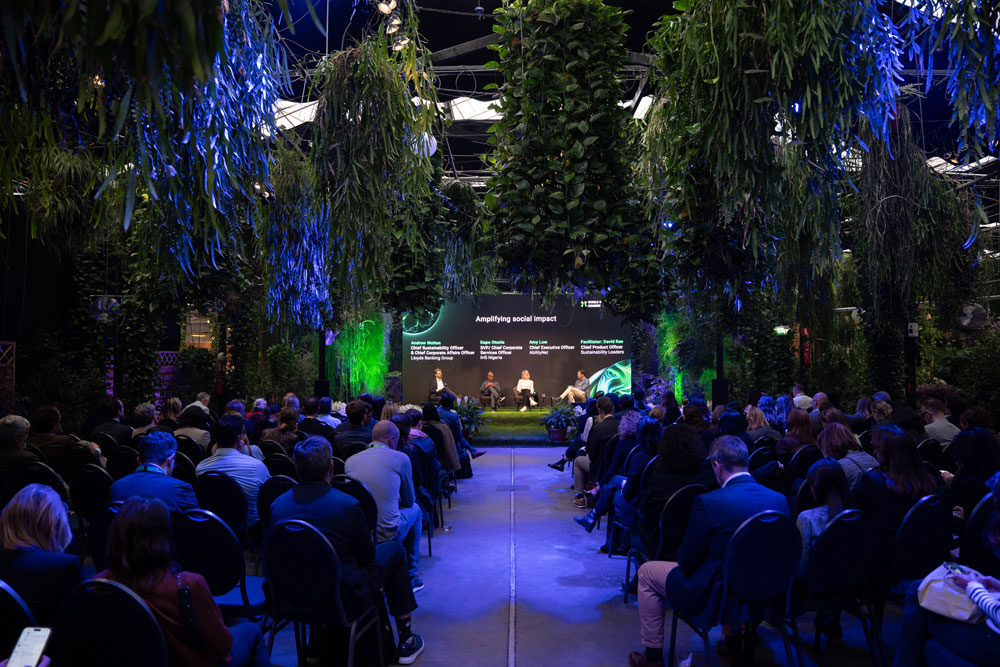

Amid the greenery in the breathtaking Garden of Amsterdam, there were more green shoots in evidence than the plants hanging from the ceiling and across the building.
Having faced down an ‘ESG backlash’ and board scepticism, around 200 CSOs and sustainability professionals came together at the World Sustainability Congress 2026 to showcase a flourishing function is ready to drive a new era of sustainable growth.
With leaders discussing issues as varied as regulations and water stewardship to artificial intelligence and the rising cost of living, here are out favourite insights from this year’s Congress.
The opportunity and impact of AI
Sustainability teams are increasingly seeing the potential value of artificial intelligence tools in their work. That ranges from automating carbon disclosure calculations to supporting suppliers in identifying the best focus areas and techniques for cutting their emissions. While there are concerns that AI’s energy use could cancel out these benefits, Mark Maslin, professor of earth System science at UCL, told delegates effective regulation could mitigate this impact. “There is no architectural reason why we cannot produce data centres that use only renewable energy, recycle their own water and are put in places where you’re not dealing with 30–40°C heat outside.”
CSOs’ opportunity to tackle the cost of living
While many organisations’ social impact strategies focus on suppliers and communities in developing countries, rising energy bills and inflation mean western companies should look closer to home as workers and customers struggle with strained financial stability. Margot Slattery, global head of social sustainability and inclusion at ISS, shared how her organisation has committed to implementing a living wage in every country in which it operates, and is working with customers to ensure the financials make sense. ISS has also created resources to support those struggling with their finances. “You can be cynical about it, but purpose and people are the main part of a constituent of the business that we provide,” she said. “There was no difficulty when we went to our board with this.”
Regulations: a useful framework
While environmental regulations often seem burdensome, companies are turning compliance into a commercial advantage. Consistent standards help ensure fair competition, driving high standards and protecting businesses from bad actors. Rather than trying to bypass regulations, organisations are learning to use them and protect revenue. Vivi Hollertt, CSO of Nouryon, said: “If we all work on the same level playing field and all companies need to deal with the same rules and regulations…this can definitely help because it will not all happen [from] the consumer because they need to look at their buying power.”
Circularity’s commercial impact
Circularity presents a huge opportunity to reduce the waste of materials and equipment, but using it successfully can rely on making the case in pure business terms – both to win internal support and to make the company more attractive to investors and lenders. That can be more straightforward than some sustainability initiatives, because reducing consumption has a direct bottom-line impact. Martin Basila, CEO and founder of circularity tech company Sensoneo, said: “We truly believe that sustainability has to go hand in hand with financial sustainability”.
Linking emissions with finances
As sustainability faces greater commercial scrutiny, leaders must connect carbon emissions data to financial metrics to drive action and identify the most valuable and cost-effective opportunities to make an impact. Dupont CSO Scott Colick said: “Carbon fluency is the language of sustainable business…it’s combining the metrics that we as engineers and scientists know how to deal with and using them with the business.” Expressing sustainability in these terms makes it easier to build business cases and win over stakeholders.
Embrace commercial realism
Standalone sustainability initiatives based solely on ethical arguments struggle to win board approval. To secure funding, sustainability initiatives must clearly support cost reduction, efficiency and margins. Vivi Hollertt, Chief Sustainability Officer at Nouryon, told attendees: “We never put forward a purely ‘sustainability’ project; we attach sustainability goals directly to existing operational investments and asset longevity to protect the bottom line.”
Adopt hyperlocal water strategies
Because water is often underpriced by utilities companies, businesses overlook their financial risk until until local shortages disrupt operations. Water management is no longer merely an internal efficiency metric requiring internal risk pricing and regional coordination. Scott McCready, chief strategy officer and acting CEO of the Alliance for Water Stewardship, said: “Water stewardship is climate change adaptation in real time; the challenge is that because water is priced cheap or free, accessing internal investment requires us to quantify its true continuity value.”
Social purpose boosts resilience
Across engineering and technical sectors, social sustainability has matured has become a priority. Amid widespread engineering shortages, engineers increasingly commit to organisations that invest in fair workplace practices and employee training. Amanda Wood, social sustainability director at BAE Systems, told delegates: “Sustainability cannot exist as a standalone strategy; when you embed purpose and social value into skills development, it becomes our strongest operational enabler and a primary talent magnet.”
The case for nature
Expecting consumers to pay more for sustainable goods is rarely a viable long-term strategy. When agricultural commodities make up most production inputs, soil health becomes vital to ensuring supply continuity and maintaining margins. As Marco Beghini, global sustainability director at Barilla Group, said: “You cannot rely on consumer price premiums to fund sustainability; the long-term transition happens only when you prove value through supply chain resilience, cost avoidance, and raw material security.”


